
Can you trust an agentic SOC investigation?
A polished case is not enough. The investigation has to survive review.
Can you inspect the evidence? Can you see what context was used? Can you ask why the investigation reached its conclusion?
That is the real test.
The case should answer questions
A case writeup from your MDR or SOC team tells you what someone wrote down.
Sometimes that is enough. Often it is not.
If an alert is marked malicious, a case reviewer wants to know why. What evidence supported that call? What else was checked? What data was missing? Was the answer high-confidence, or was the investigation working with partial context?
Those are normal SOC questions. Every analyst, manager, and incident responder asks them.
Done well, an agentic investigation should make those questions part of the workflow. A case reviewer should be able to see why the conclusion was reached, what evidence supported it, what was checked, what assumptions were made, and what would change the answer.
A reviewer needs enough detail to answer basic SOC questions:
- Why was this classified as malicious?
- What evidence supported the conclusion?
- What else was checked?
- What data was missing?
- What assumptions were made?
- What would increase confidence?
- What would change the conclusion?
With an agentic approach, the reviewer is not stuck accepting a polished case at face value. They can interrogate the investigation.
Why this is different from analyst notes or playbooks
Security teams already document investigations. Analysts write notes. MDR providers send cases. SOAR platforms run playbooks. All of that is valuable.
Each model has a different review problem.
With a human analyst, much of the reasoning may live in the analyst’s head. The case may summarize the conclusion, but it may not show every branch of the investigation. Fully documenting that reasoning takes time, and in practice, analysts often spend that time investigating the next threat instead of writing down every step they took. If the reviewer wants to understand a specific call, they may need to find that person and ask.
With automation, the reasoning usually lives somewhere else. It sits in rules, conditions, playbooks, API calls, parameters, and workflow logic. Once a playbook is built, it often sits untouched until something breaks. But alerts change, context changes, and future cases may include data points the playbook author never anticipated. If the system behaves in a surprising way, someone may need to inspect the playbook to understand what happened.
With a traditional MDR or SOC case, the customer gets what the analyst or provider chose to document. That may be useful. It may also be static. If the customer has a follow-up question, they may need to investigate manually or go back to the provider.
Done well, an agentic investigation works differently. The reviewer can ask why the conclusion was reached, and the agent should be able to use available tools and context to answer.
Manual investigations often hide reasoning in someone’s head and automation hides it in code. Agentic investigation can expose reasoning inside the case.
What you should be able to inspect
A reviewable AI investigation should make the important parts easy to see.
Here is an example:
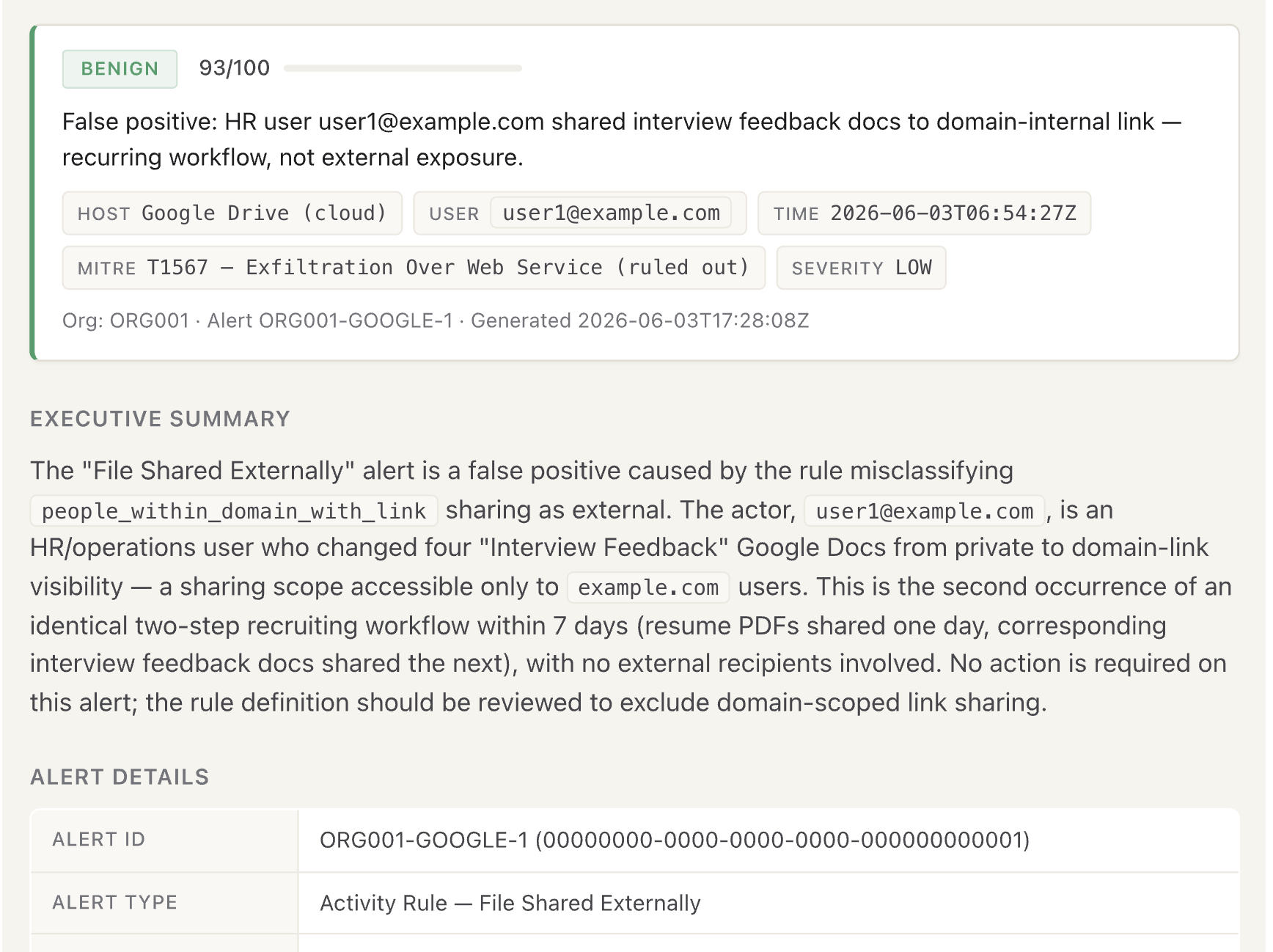
Start with the conclusion. What does the investigation say happened? Was the alert benign, suspicious, or malicious? What is the recommended next step?
Then inspect the evidence. Which URLs, domains, users, devices, IPs, files, alerts, or log sources support the conclusion? Which signals mattered most? Which were weak?
Then look at confidence and uncertainty. A confidence score should not be decoration. It should tell the reviewer whether the investigation had enough context to support the answer.
Then look for missing data. This is where many AI systems get into trouble. A confident answer with missing context can be dangerous. A lower-confidence answer that names the missing context gives the reviewer something useful.
Finally, the reviewer should be able to ask follow-up questions: why the call was made, what else was checked, what data would change the conclusion, and what the investigation recommends next.
At that point, review is part of the investigation. The work can be inspected, challenged, and improved.
Context changes the answer
A security investigation depends on context. Pretrained knowledge can tell you what something might mean. Enterprise context tells you what it means here.
Take a malicious URL alert.
If an AI analyst sees a malicious URL in an email alert, it may be able to explain why the URL looks risky. It may know the domain has a suspicious reputation, or that the URL structure resembles a credential-harvesting pattern.
One thing matters immediately: did anyone click?
If proxy logs or user activity logs are missing, the investigation may not be able to answer that with confidence. The case should say that. It should show the missing data. It should explain what additional source would increase confidence.
If the agent can connect to those logs, the investigation can go further. It can check whether the user clicked, whether the URL loaded, whether credentials were entered, whether the device showed follow-on activity, and whether the incident needs escalation.
The alert did not change. The context did.
Now take a DLP alert.
A user moved sensitive data into a SaaS application. In isolation, that may look risky.
If someone in finance moved data into an approved finance or payroll application, that may be normal business activity. If a random employee moved Social Security numbers into an unapproved third-party application, that deserves a different answer.
The surface behavior may look similar. The enterprise meaning is different.
That is why an agentic investigation has to show what it knows, what it checked, and what it still needs.
A case that shows its gaps gives the reviewer something to work with.
Human review still matters
Security operations already run on review.
SOC managers review cases. Senior analysts challenge conclusions. Teams tune processes when they find gaps. AI in the SOC does not remove that discipline.
Systems drift. Integrations break. Data quality changes. Customer environments differ. Business context matters. Response actions carry risk.
Someone still owns the outcome.
That does not mean a human analyst needs to redo every agentic investigation by hand. The right approach is quality control: inspect enough of the work, challenge the reasoning when something looks off, correct the system when context is missing, and set boundaries around response.
Trust, but verify.
Trust what you can inspect
An agentic investigation should earn trust through the evidence, reasoning, and gaps it shows.
Can you…
- See the evidence?
- Understand the reasoning?
- Ask follow-up questions?
- See what data was missing?
- Judge whether the conclusion is good enough to rely on?
FAST from AirMDR gives security teams a way to test this directly. Run an agentic investigation on your own alerts. Inspect the evidence. Ask why the agent reached its conclusion. Look at what it knew, what it assumed, and what context it still needed.
Then decide whether the investigation is good enough.

AUTHOR:
Kumar Saurabh
Kumar Saurabh, CEO of AirMDR, has 20+ years in enterprise security, including roles at ArcSight and LogicHub.
In this article