
The renewal moment
Your MDR contract is coming up. Your provider has been responsive enough. Tickets are flowing. Reports arrive. Nothing catastrophic has happened. The easy path is to renew.
Not because it's clearly working – but because it's not clearly failing. In security, that is often enough to avoid a harder conversation.
But "nothing blew up" is not the same as "this service is delivering the quality we need." And renewal is one of the few moments when you have both the leverage and the reason to ask whether the current model still matches what the organization actually needs.
The renewal question is not just "did our MDR provider do the job?" It is "do we have enough visibility to know?"
Coverage and investigation quality are not the same thing
Traditional MDR solved a real problem. Lean teams got 24/7 coverage, alert triage, escalation support, and access to security operations expertise they couldn't reasonably build or staff themselves. For organizations without a fully staffed SOC, that was – and still is – genuinely valuable.
But coverage tells you someone was watching. It doesn't tell you what happened after the alert arrived.
Case write-ups are the only lasting artifact that proves the investigation work was done. When they are incomplete, every downstream function – shift handoffs, escalations, incident reviews, leadership reporting, audit prep – runs on assumptions rather than evidence. That's not just a a documentation problem, it operational risk that compounds until someone asks what happened and there's no clear answer.
The question most MDR renewal processes fail to ask: can you pick up a closed case cold – no context, no tribal knowledge, no call with the analyst – and understand what triggered the alert, what was investigated, what the evidence showed, and why the conclusion made sense? If the answer is no, you're not evaluating investigation quality. You're still being asked to trust the provider instead of the work.
Related resource: AirMDR's SOC Case Quality whitepaper covers what "good" actually looks like in a case write-up, why the industry has lacked a consistent standard, and how AI makes case quality measurable at scale.
The typical renewal scorecard hides the real problem
Most MDR renewals get evaluated on a list of familiar criteria: price, SLA adherence, ticket volume, escalation responsiveness, reporting quality, and whether the relationship has been easy to manage. Those things matter. A provider that misses SLAs or goes dark during an incident is a real problem.
But they also paint an incomplete picture – and in some cases, a misleading one. A provider can hit every SLA, deliver polished quarterly reports, and still leave the organization with investigations that can't be understood, verified, or defended.
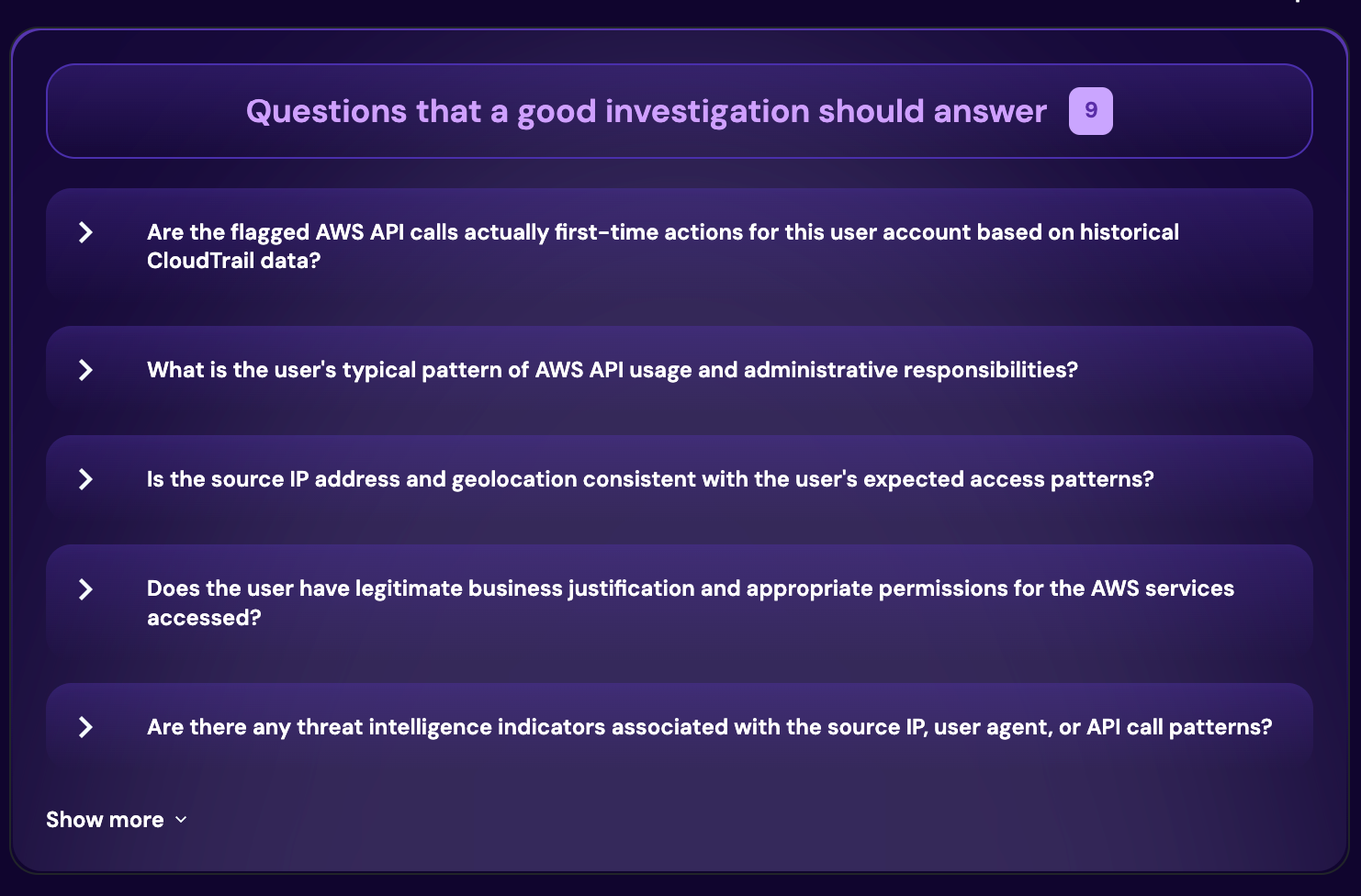
The scorecard many teams use measures whether the provider was present. It doesn't measure whether the work was any good.
The harder questions don't show up on most renewal checklists:
- Are investigations consistently backed by evidence, or are conclusions asserted without showing the work?
- Are closed cases clear enough for someone outside the original investigation to act on?
- When alerts are escalated or closed, is the reasoning explicit – or is it just a verdict?
- Has investigation quality improved over the contract period, or has the team been accepting "good enough" because there was never a consistent way to measure it?
- Can the provider prove what was done, or only report that something was done?
Those questions are harder to answer than the operational ones. Activity reporting is not the same as quality. And at renewal, the difference matters.
What AI MDR changes, and what it doesn't
Not every MDR provider that mentions AI has changed how investigations actually work. AI that summarizes tickets, suggests responses, or helps analysts write faster is useful. It is not the same as AI that changes the investigation itself.
What AI MDR should change in the investigation
AI MDR is worth serious evaluation when AI changes how investigations are performed and documented – not just how efficiently an analyst can summarize, document, or close a ticket. The distinction matters because the outcome is different.
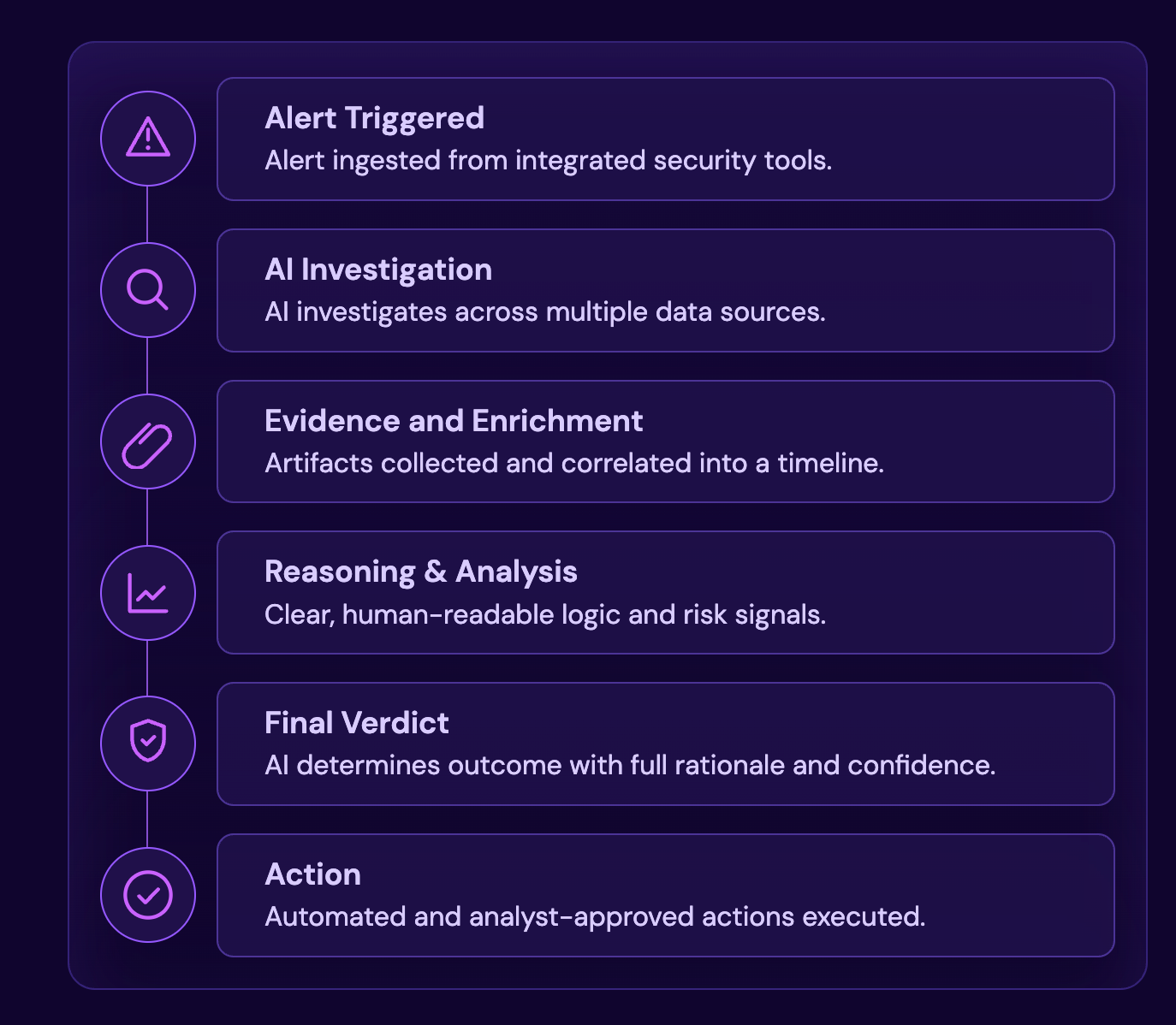
In AirMDR's model, AI investigates across integrated data sources, gathers evidence, builds attack timelines, and generates transparent cases with explicit reasoning. Human experts review the work, tune detection logic, provide oversight, and remain accountable for the outcome. The investigation isn't summarized after the fact. It's built by AI and validated by humans – which means the case reflects the evidence gathered, the reasoning applied, and the conclusion reached – not just what an analyst had time to write down before moving to the next alert.
That's worth comparing at renewal: does AI change what the investigation produces?
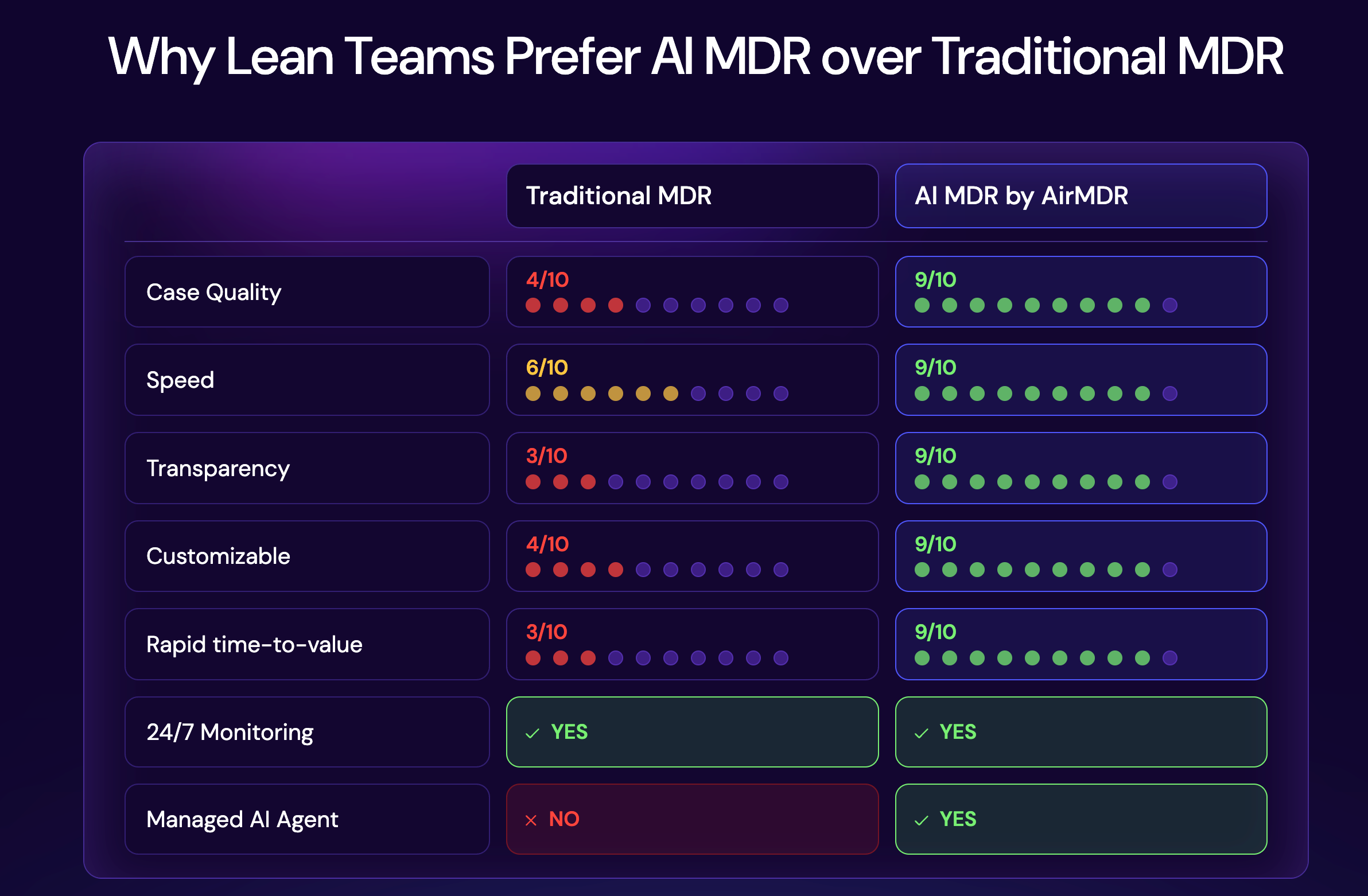
Why this matters for lean teams
Lean teams don't want another platform to staff, tune, and operate. They want better outcomes: faster investigations, clearer cases, broader coverage, and human accountability – without building or running their own AI SOC operating model.
Some MDR providers use AI to make the existing model faster: summarize tickets, assist analysts, or close cases more efficiently. That can help. But it does not necessarily change the quality of the investigation. AI MDR should do more than accelerate the old workflow. It should produce better investigations: clearer evidence, stronger reasoning, faster triage, and cases the customer can actually trust.
For lean teams evaluating MDR at renewal, that is the real distinction. The value is not another tool to operate. It is a better MDR outcome from a category they already understand and budget for.
What to ask before you renew
Before the renewal conversation starts, these are the questions worth bringing to it.
Can we see the evidence, timeline, and reasoning – not just the verdict? A closed case should show what was investigated, what the evidence showed, and why the conclusion made sense. A verdict without a trail is an assertion, not proof.
Are cases clear enough for someone who wasn't there? Handoffs, incident reviews, audits, and leadership reporting all depend on casework that doesn't require a phone call to interpret. If every case requires the original analyst to explain it, the case is not doing enough of the job.
Does the provider investigate across enough of our stack? Narrow visibility limits investigation quality regardless of how good the analyst is. Context matters. An investigation that can only see part of the environment may miss things the full picture would catch.
Is AI part of the investigation workflow, or just an analyst assist? Useful AI features are not the same as a redesigned investigation model. The question is whether AI changes what the investigation produces, not just how fast an analyst can close the ticket.
Where do humans stay accountable? AI can accelerate the work. Someone still needs to own the outcome. Know where that accountability lives and what it covers.
How fast can we prove value? Renewal windows are practical. A provider that takes months to demonstrate measurable results creates renewal risk, even if the price looks attractive.
Can quality be measured over time – not just activity reported? Ticket counts and SLA reports describe volume. They don't describe whether investigations are getting better. If quality can't be measured, it can't be managed.
For teams that want to go deeper: case quality can now be evaluated with a consistent rubric rather than gut feel or sporadic spot checks. But even without a formal scoring program, renewal is the right time to ask whether your MDR provider can show the evidence, timeline, and reasoning behind every investigation – not just confirm that the alert was closed.
The standard for MDR is moving. The old question was whether someone was watching. The new question is whether you can trust what happened after the alert fired.
Compare AI MDR vs. Traditional MDR

AUTHOR:
Raphael Reich
Raphael Reich is the Chief Marketing Officer at AirMDR, where he leads go-to-market strategy and brand growth. With over 20 years of experience in cybersecurity marketing, he has helped companies like CyCognito and Seemplicity bring innovative security solutions to market and scale their impact.
In this article